
 :
:
The circular economy is moving from the “liminal space” to “will.” While we exist in the liminal space, wavering between the linear economy and the circular economy, the presence or absence of our own will determines the status of this transition.
As the evolution and deepening of the circular economy continue, it is well known that uncertain factors, such as the increasingly unstable international situation and the rapid rise of AI, continue to multiply. How should we interpret these developments, and what kind of future vision should we draw as we move forward?
Last year, we identified the following five themes for the circular economy in Japan in 2025:
“Backlash”: Capturing circular economy from both forecasting and backcasting perspectives.
Standardization: Formulation and understanding of domestic and international standards.
Regional Expansion: Surface-level expansion of circular economy in local areas.
Business Models: Deepening, evolution, diversification, and scaling of circular business models.
Japanese Context: Deepening the Japanese version of the circular economy and capturing overseas markets.
These five themes will continue to be—or rather, become increasingly—important in 2026. Below is the consideration of the future macro outlook, including a reflection on these points.
Backlash: An Opportunity to Integrate Circular Economy into Business and National Strategy
The Omnibus package to strengthen EU competitiveness and the rollback of climate policies by the current U.S. administration are perceived as a “backlash” against environmental policy and sustainability. However, looking at the flip side, this is a prime opportunity to integrate sustainability, including the circular economy, into business and national strategy.
A September 2025 article in Harvard Business Review (HBR), “Are Companies Actually Scaling Back Their Climate Commitments?“, points out that “integration into business” is one of the common traits of companies that can sustain their sustainability efforts. It analyzes that companies placing sustainability at the core of value creation are less susceptible to external political pressure. In other words, integration into business means that these efforts appear attractive to external stakeholders, including many investors and public institutions, as an enhancement of business value.
Relatedly, with the penetration of the circular economy, circular products and services are increasingly facing situations where their value is directly compared with traditional linear products and services. This may be an inevitable passing point toward the circular economy transition—or to put it another way, it may mean that the distance between the circular economy and the traditional economy is narrowing as they meet in the liminal space.
Under these circumstances, there are cases where some companies are revising ambitious goals set through backcasting or ending innovative PoCs, and there is a narrative that we should lean toward the forecasting model at which Japan has traditionally excelled.
Needless to say, backcasting allows for bolder choices by thinking from the future and drawing a line back to the present, but if it is too far from the ideal, corrections are inevitable. On the other hand, forecasting can fall into incremental improvements or lose sight of the big-picture goal, but it has the merit of allowing for grounded activities. It is a reminder that rather than one being better than the other, utilizing both effectively is essential for achieving goals.
Economic Security as a Focal Point
Securing resources for the transition to carbon neutrality has become an urgent challenge, and the focus is on utilizing recycled materials, including the development of urban mining. There are concerns that copper and aluminum will fall into supply shortages in the medium to long term, and demand for minerals such as cobalt, lithium, and nickel is expected to expand. While friend-shoring to reduce geopolitical risk and the development of alternative products that do not use specific minerals are progressing, the importance of resource procurement through recycling existing products increases as another path. 2025 was a year in which this aspect of “Circular Economy contributing to Economic Security” became increasingly strong.
In the U.S., while climate change policy as an environmental measure has receded, policies that contribute to “Make America Great Again (MAGA)” are maintained. For example, the administration is proactive toward policies that revive domestic industries and realize resource autonomy, such as tax credits for non-fossil-derived U.S. bioenergy and critical mineral recycling.
In the EU, a Circular Economy Act is scheduled in 2026. The Circular Material Use Rate (CMUR) in the EU has only slightly increased from 10.7% in 2010 to 12.2% in 2024*1, despite the effort put into the circular economy. The Circular Economy Action Plan (2020) originally set a goal to double the circular material use rate by 2030 compared to 2020, and the Clean Industrial Deal (2025) also set a numerical target of 24%.
However, in the plastics sector, for example, the European plastics recycling industry is on the “brink of collapse” due to the inflow of cheap recycled materials from Asia and rising energy costs. In Europe, numerous plants have closed, particularly in the field of material recycling for plastics. Some estimates suggest that approximately 1 million tons of recycling capacity will be lost between 2023 and the end of 2025*2. Simultaneously, there are successive cases where plans and investments regarding chemical recycling are being shelved. Virginia Janssens, Managing Director of Plastics Europe has expressed a strong sense of crisis, stating that “The European plastics industry is at a cliff edge as competitiveness collapses.”*3
The background to this is the decline in competitiveness of European recycled materials due to cheap virgin and recycled materials coming from overseas, especially Asia, the lack of unified End of Waste (EOW) criteria, and soaring energy and labor costs. The upcoming Circular Economy Act also has the aspect of preparing the environment to build a recycled material market within the region.
We need to think carefully about what this situation means for Japan. In Japan as well, working to strengthen supply chain networks centered on recycled materials is reaching a level that could be called a “survival strategy.” Furthermore, we must not forget that not only recycling but also smaller loops such as sharing, life extension, repair, and remanufacturing contribute to economic security.
Standards: Our Will is Questioned
Rules for the transition to a circular economy are being prepared. The biggest news of last year was likely the announcement of the Global Circularity Protocol. Additionally, while ISO 59004 and 59010 were formulated in 2024, revision work has already begun starting from the ISO/TC323 Jamaica Plenary Session in October 2025. Furthermore, Norway has proposed ISO 59001, a certification standard equivalent to the circular economy version of ISO 9001 and 14001, and standard setting work is underway.
Standards are being prepared. However, in Japan, the actual feeling is probably that we are still “far from implementation.”
While rules have been created, in the current situation where legal binding force and incentives are generally lacking, what is most important is our “will.” Whether aligning corporate management systems with circular economy standards or conducting circularity assessments, it is necessary to devote time to setting objectives and building consensus on what we want to achieve and what our purpose is.
Japan’s Circular Economy is Full of Potential
The term and concept of the circular economy itself developed mainly in Europe. By utilizing this concept while combining it with the “Circular Society” systems that Japan has uniquely built to date, we can create a major impact both domestically and internationally. Issues associated with a declining population, abundant forest resources, history and culture, a robust material and manufacturing industry, and high awareness of waste collection and separation—an increasing number of companies and municipalities are redefining Japan’s unique resources and strengths and working on activities from a circular economy perspective.
Last year, I heard from a European company that “Compared to Europe and the U.S., the environment and corporate awareness surrounding sustainability in Japan are stable. We want to invest proactively.” Such voices give hope to the circular economy in Japan. It is also certain that the fact that GX (Green Transformation that the Japanese government has promoted) continues to be positioned as a growth field in Japan provides it with an independent position unaffected by politics. The circular economy, which constitutes one part of GX, is expected to remain one of the focus areas contributing to growth and economic security.
2026 will be a year in which circular economy initiatives that take into account Japan’s unique circumstances accelerate in various fields. And it is expected that the unique circular models and technologies that Japan has built will finally be strongly communicated to overseas markets, leading international discussions.
Macro Trend in Japan 2026
Because the circular economy has diverse aspects as shown below, while maintaining a medium-to-long-term circular vision, it is necessary in the short term to illuminate each focus with will.
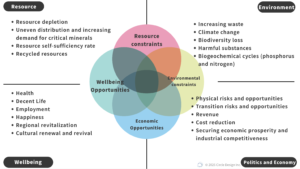
Based on the above perspectives, Circular Economy Connect Lab has picked five macro trends in Japan to watch in 2026.
1. Circular Economy Contributing to Resource Autonomy
Movements toward establishing recycled material markets occurring globally, including the enactment of the Circular Economy Act in the EU.
Vertical integration of supply chains by companies.
2. Penetration of AI into the Circular Economy
Progress in AI utilization at all stages of the supply chain; evolution of the data-driven circular economy.
The birth of “Circular AI Agents.” (A term coined by the author referring to AI that supports human activities based on circular or general environmental value in various decision-making situations.)
3. Development of CE Commerce (Reuse, Sharing, Repair, etc.)
Continued expansion of the reuse market in particular. An increase in brands starting their own resale operations.
4. “Utilization” of Standards
How to utilize—or choose not to utilize—the various standards being prepared.
5. Deepening of the Japanese-style CE Image and Overseas Collaboration
Spread of regional circular models (or Circular City) ; circular economy as a means of solving regional issues; communication and contribution to overseas markets including culture.
Infrastructure development for the expansion of circular trade; construction of circular supply chains; regulatory alignment; diversification of resource procurement.
Kiyokazu Nasu
Circular Economy Connect Lab (Circle Design)
Original Text (Japanese) : https://circledesign.co.jp/circular_post/circular-economy-2026-trend/
*1: Circular material use rate in Europe: European Environment Agency
*2:2024 Data Reveals a Deepening Crisis of the European plastics recycling industry, Plastic Recyclers Europe
*3:European plastics industry at cliff edge as competitiveness collapses: Plastics Europe