 :
:
The Circular Economy Connect Lab interviews advanced practices of the circular economy by companies and municipalities. We extract these as “Circular Knowledge” (a collective term for conceptual and practical knowledge toward CE transition) that can be horizontally deployed to build a foundation for accelerating the social transition to CE. Each installment consists of an “Interview (Part 1)” and a “Circular Knowledge Translation (Part 2).”
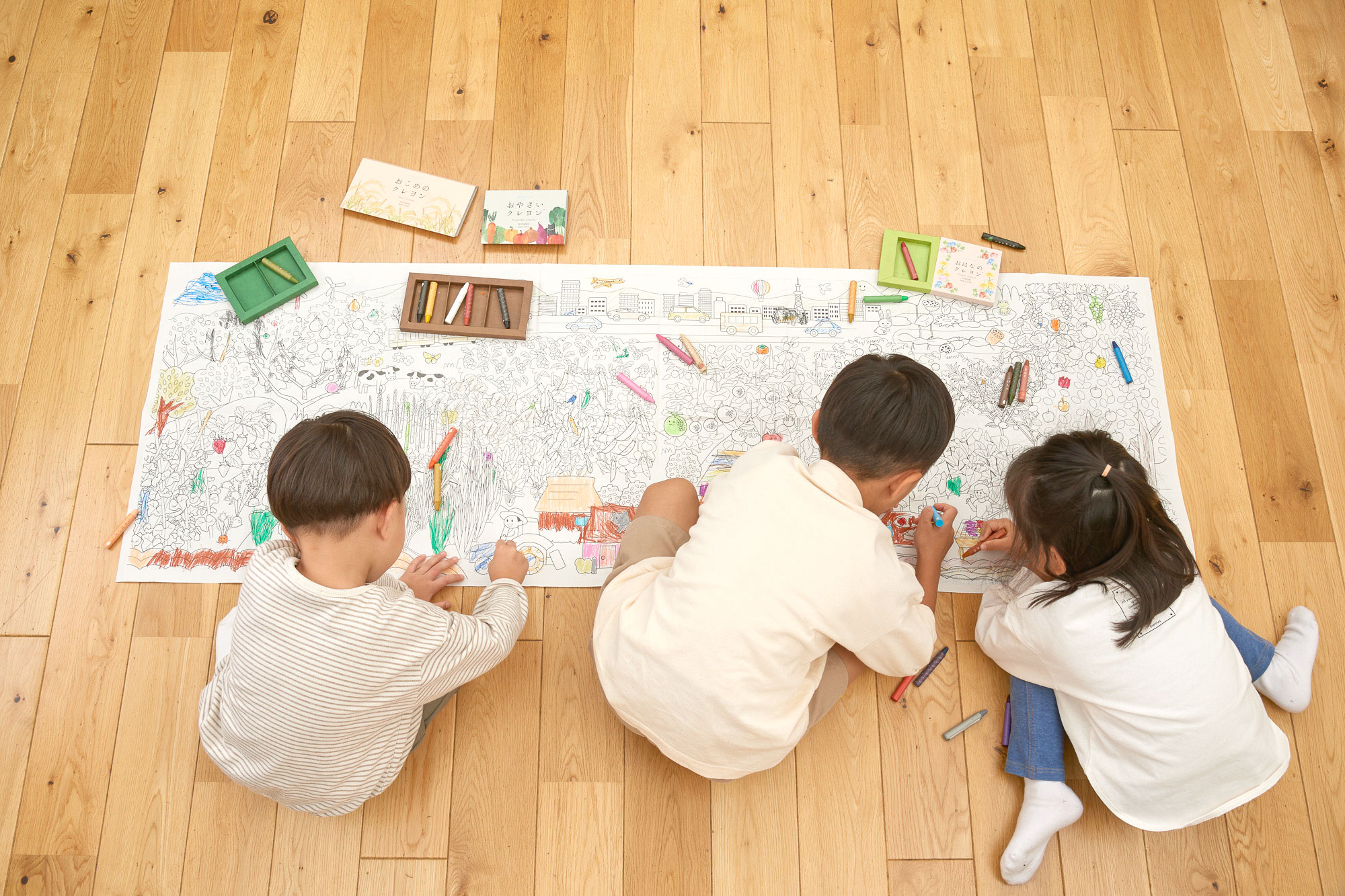
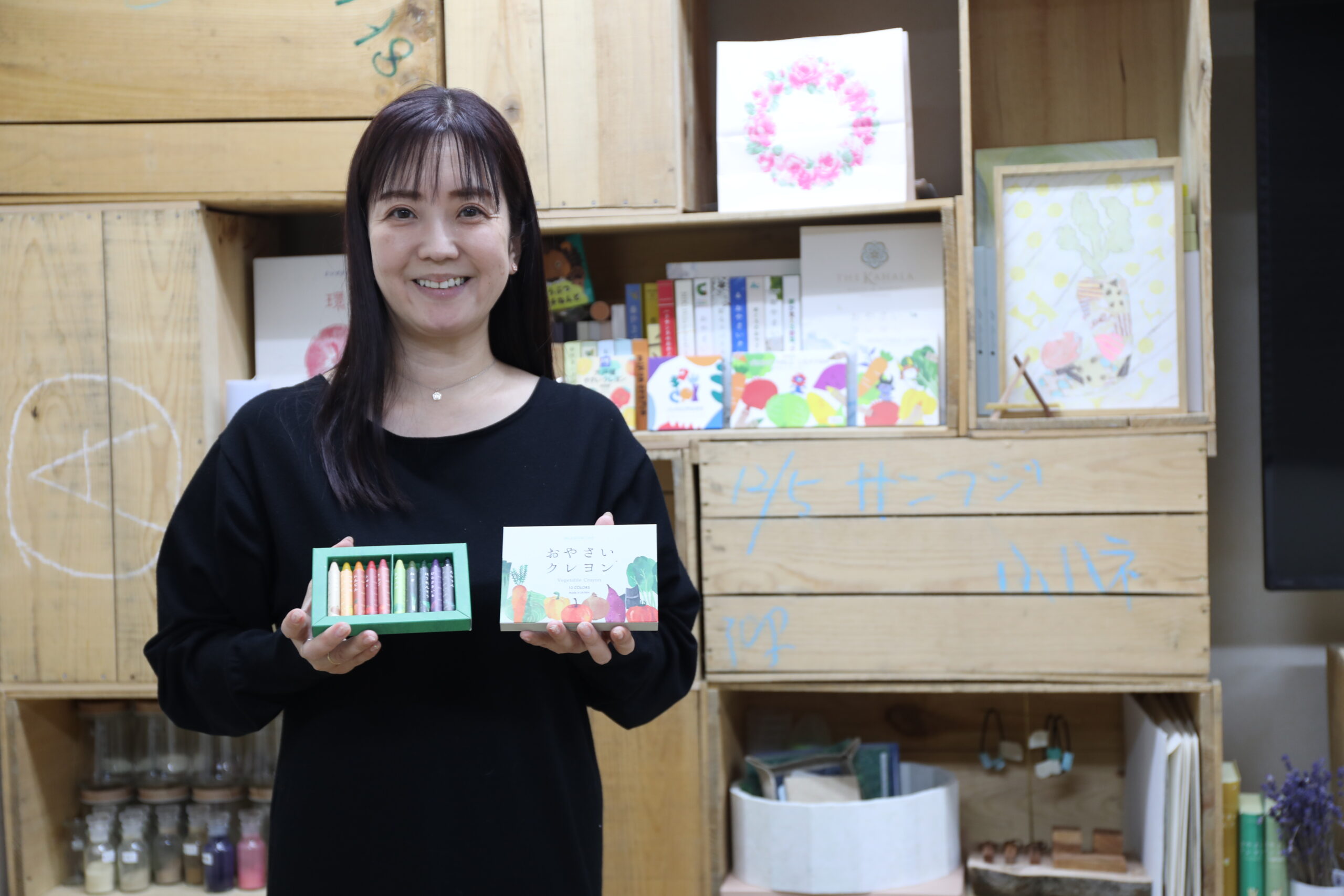
In this session, we interviewed Ms. Naoko Kimura, CEO of mizuiro Inc., known for her company’s product “Oyasai Crayon” (Vegetable Crayons). The product uses rice oil and rice wax—upcycled from rice bran—as a base, blended with powders made from non-standard vegetables that cannot be sold in the market (this is a deep rooted challenges in Japan when tackling with food waste) and byproducts from agricultural production. Made entirely from ingredients safe enough to be accidentally ingested, it is said to be a unique vegetable-based crayon globally. Beyond its originality and safety, its educational value for food awareness has garnered broad support, particularly among households with children.
While upcycling unused resources and reducing food waste has become common recently, mizuiro began its activities in the early 2010s, well before these terms gained social traction. As a pioneer in the field, Ms. Kimura shared her story from multi-faceted perspectives, including the founding story, her vision, business construction, and the inherent value of Oyasai Crayon.
It Began with “Beauty”
Ms. Kimura did not start with “upcycling” or “circular economy” in mind. “From the beginning, I wasn’t thinking about upcycling or anything like that. The starting point wasn’t there; it was simply a desire to create an original product,” she explains.
Originally working as a graphic designer in Aomori Prefecture, Ms. Kimura ran an online shop for overseas stationery as a hobby, which eventually led to her wanting to create her own products. Her first focus was indigo dye ink and the colors of vegetables. Inspired by the beauty of natural colors at an exhibition, she expanded her ideas toward vegetables. “Since there are indigo dyeing initiatives in Aomori, I thought it would be fun to turn natural colors into ink and use vegetable colors for the variations.” While the indigo ink faced technical and budgetary hurdles, her pursuit of “drawing with vegetable colors” eventually landed on crayons—the first art tool children touch.
Building a Network to Realize “Oyasai Crayon”
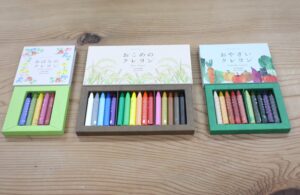
Oyasai Crayon (along with Okome (rice) Crayon)
To commercialize the product, it was necessary to develop a diverse supplier network of farmers, food manufacturers, and crayon manufacturers to create collaborative relationships.
Ground-up Procurement: While they now have stable suppliers, in the early days, she built the network through public appeals on social media and introductions from the Aomori Prefectural Government. Farmers generally reacted positively, saying, “I’m happy if they can be utilized.” She notes, “They usually compost them, so they found it interesting that they could be reborn as stationery.”
The Challenge of Volume: As a company that also handles OEM, securing large quantities of raw materials was a major hurdle. “For OEM, we need to produce tens of thousands of sets, which requires a massive amount of vegetables. Sourcing that was difficult.”
Secret Collaboration with a Veteran Manufacturer: Production is handled by a domestic crayon studio. It started when Ms. Kimura saw a YouTube video of the studio demonstrating traditional manufacturing methods and called them directly. The third-generation representative wanted to create a hit product to rival those of his father and brother. “The third-generation leader also hoped to create a hit. However, vegetable-based crayons were unprecedented, and his predecessors were against it. So, at first, he cooperated by repeating prototypes in secret.”
Regarding the pale colors produced by vegetable powder, they worked together to redefine the concept of color. When the product finally debuted at a trade fair (its name is “Gift Show”), the booth was overwhelmed with visitors, and business deals followed quickly. “The studio’s brothers also came to the booth, and even the older brother said, ‘That’s great.’ It was the moment Oyasai Crayon truly saw the light of day.”
Embodying Value and Branding
One of Ms. Kimura’s primary focuses during commercialization was a naming and brand universe that balanced performance with emotion. “Among various candidates, I wanted a name that conveyed the performance well, so we decided on ‘Oyasai Crayon.’ Adding the ‘O’ (a polite prefix in Japanese) gave it a softer impression. This clear naming was the first pillar of branding.”
Furthermore, she found the brand’s philosophy in “imperfection.” “The second pillar is striking a different value system for color—not being too obsessed with traditional color concepts. Even if there is no blue, I want users to express themselves by supplementing missing colors with their imagination.”
“For the packaging, I avoided designs that were too ‘childish’ and focused on something simple and chic that could be used as a gift. I simulated personas and use cases, imagining scenes where parents and children use them together.”
Expanding Regional Circulation through Multiple Outlets
As a new venture, the company has started OEM businesses that transform waste materials into valuable products, including paper, flowers, fiber, and plastic. For example, they produced cardboard for an Aomori apple juice manufacturer by mixing apple pomace (juice scraps) into the paper. This reduces the use of wastepaper and suppresses the consumption of new pulp resources.
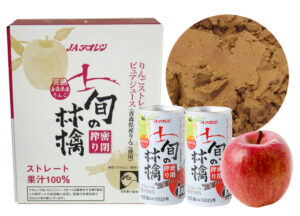
Cardboard made from apple pomace generated during the juice-making process. (Photo: mizuiro Inc.)
To maximize regional resource circulation, she has built a system that utilizes secondary resources as much as possible by combining different outlets: crayons (small volume/high value) and apple cardboard (large volume/industrial utility).
From a “Product” to a “Meaningful Moment” for Families
Ms. Kimura’s gaze is fixed on the next generation and a “circulation of memory.” “My big goal is to become a brand where Oyasai Crayons continue to be used across generations.”
The product inherently contains educational elements, which themselves constitute value. “What I value most is having children become familiar with vegetables while having fun. I want them to naturally develop a sense of ‘Mottainai’ (gratitude for resources) through play.”
These experiences may eventually serve as a bridge for children to connect with their parents’ affection and philosophy as they grow. “I want to create products where the happy memories of using crayons are passed down. I hope that when children grow up, they realize why their parents chose these crayons, and then pass that on to the next generation.”
In the next installment, we will ‘translate’ Ms. Kimura’s journey and philosophy into ‘Circularity Knowledge’ that can be utilized by other companies and regions.
Photos: Photographed by Circular Economy Tsuna-gu Lab (Circle Design Co., Ltd.) unless otherwise noted.