 :
:
The Circular Economy Connect Lab interviews advanced practices of the circular economy by companies and municipalities. We extract these as “Circular Knowledge” (a collective term for conceptual and practical knowledge toward CE transition) that can be horizontally deployed to build a foundation for accelerating the social transition to CE. Each installment consists of an “Interview (Part 1)” and a “Circular Knowledge Translation (Part 2).”
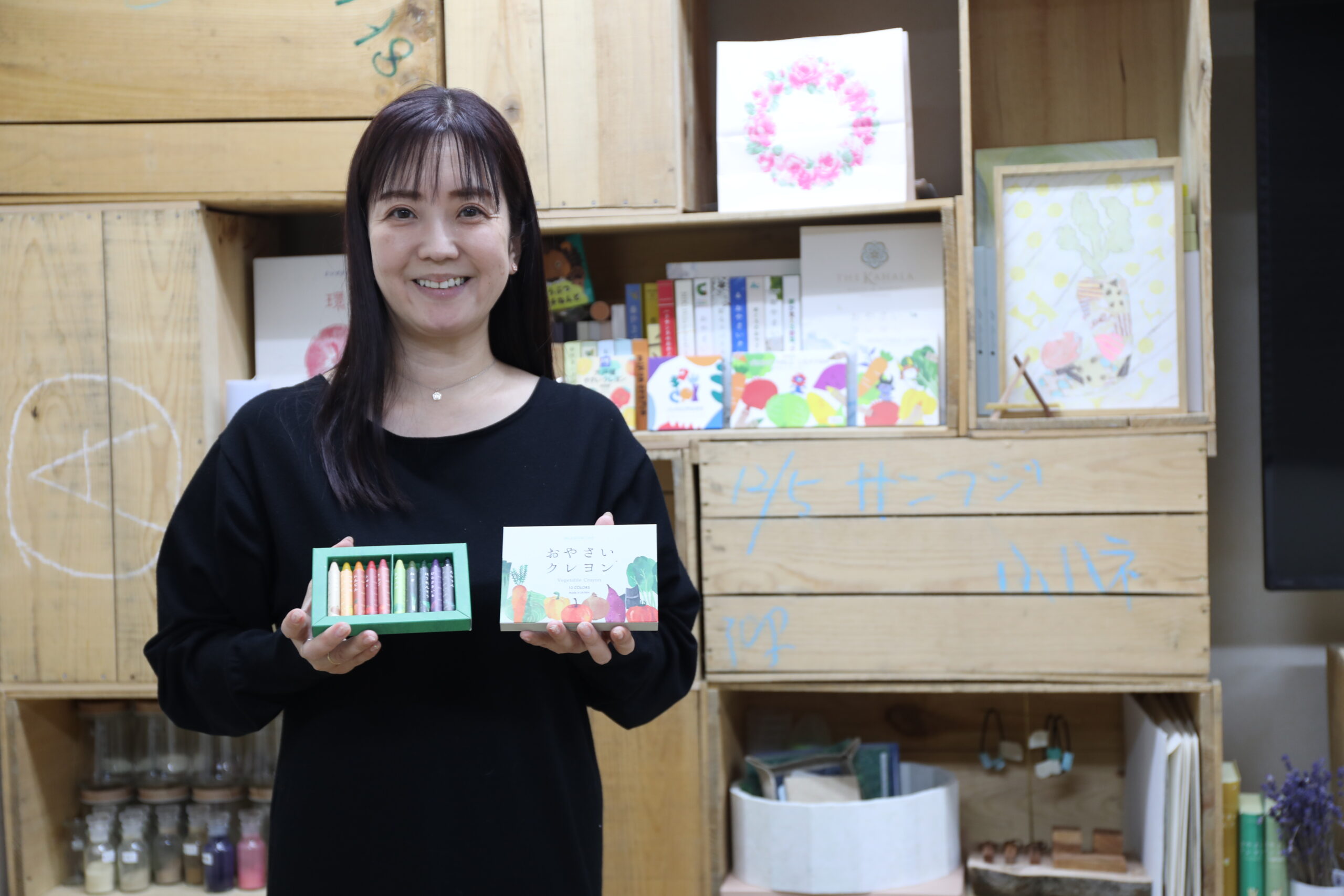
In this session, we interviewed Ms. Naoko Kimura, CEO of mizuiro Inc., known for her company’s product “Oyasai Crayon” (Vegetable Crayons). The product uses rice oil and rice wax—upcycled from rice bran—as a base, blended with powders made from non-standard vegetables that cannot be sold in market (this is a deep rooted challenges in Japan when tackling with food waste) and byproducts from agricultural production. Made entirely from ingredients safe enough to be accidentally ingested, it is said to be a unique vegetable-based crayon globally. Beyond its originality and safety, its educational value for food awareness has garnered broad support, particularly among households with children.
While upcycling unused resources and reducing food waste has become common recently, mizuiro began its activities in the early 2010s, well before these terms gained social traction. As a pioneer in the field, Ms. Kimura shared her story from multi-faceted perspectives, including the founding story, her vision, business construction, and the inherent value of Oyasai Crayon.
In Part 2, following the interview in Part 1, we organize the practices of mizuiro Inc. into four key concepts to “translate” them into Circular Knowledge.
1. “Beauty” as the Foundation of Circulation (Art Thinking as a “Hidden Infrastructure”)
Based on Ms. Kimura’s innate sense of beauty, she pursued the ideal form of her product until it felt truly “right” to her. As a result, the business naturally aligned with CE principles.
This is evident in the evolution of her material selection. “I believed natural ingredients were ideal, so I took action with what was possible at the time while gradually moving toward that ideal. In the prototyping stage, we shifted from petroleum-based materials to beeswax, then to vegetable oil. We eventually utilized rice oil, and I feel the combination of rice and vegetables creates a very Japanese narrative,” she says. She moved forward step-by-step while holding onto her ideal.
Initially, she considered using standard edible vegetables, but she felt a sense of conflict. “I felt somewhat uneasy about intentionally turning food into stationery. It was then that a farmer told me about the existence of non-standard produce that cannot be sold on market. Investigating further, I learned about the massive volume of wasted vegetables. That was when the idea of utilizing ‘Mottainai’ finally clicked for me.”
Her intuition for “Beauty” eventually aligned with “Righteousness.” It is clear that Ms. Kimura did not start with keywords like “upcycling” in mind. However, her Art Thinking—the sensibility to view the colors of raw vegetables as “beautiful” in their own right—inevitably led her to embody CE. This often-overlooked “hidden foundation” connected her unease about using food to the utilization of non-standard produce and guided her pursuit of the ideal toward bio-based materials (rice oil). This reaffirms that honing one’s philosophy, sensibility, and aesthetics is the ultimate base for the transition to CE.
2. Realizing Biological Cycles (Cascading Use and Multi-layered Outlets)
Oyasai Crayon and the upcycling initiatives born from its expertise are circular methods that make sense from the perspective of biological cycles. Simultaneously, this circular mechanism itself constitutes the product’s value.
The benefits are multi-faceted. For farmers and food factories, it is not just about reducing waste disposal costs; it is an opportunity for what was once “waste” to be reborn as new value. For the crayon manufacturer, it was a chance to bring an unprecedented product to the world using their traditional techniques.
Furthermore, the value enjoyed by users is multi-layered: contributing to food education and food loss reduction, increasing self-affirmation by choosing circular products, and, above all, creating quality time for parents and children. Together, these elements form the uniqueness of Oyasai Crayon.
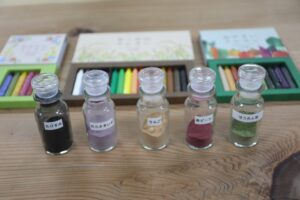
Vegetable powder used in the product.
However, to scale these values, the implementation of larger biological cycles is essential. This led to their new challenge: the material upcycling business. The “Apple Cardboard” project is a symbolic example. It combines outlets with different characteristics: crayons (small volume/high value) and cardboard (large volume/industrial utility). In upcycling unused resources and scraps, creating both quality and quantity of “outlets” is key, and mizuiro is embodying this strategy.
3. The “Koto” Perspective (Co-creating value through narratives to foster Emotional Durability)
While the importance of shifting “from products (Mono) to experiences (Koto)” has been discussed extensively, Oyasai Crayon is a product that intentionally embodies this.
Beyond its high circularity as a physical product, its value lies in turning the user’s experience into a “Koto” (a meaningful event). Specifically, this refers to the narrative of “scenes where parents and children use it together” and “memories being passed down to the next generation.” Oyasai Crayon exists as a tool to color precious family time. In other words, the brand co-creates value with customers through the “Oyasai Crayon narrative.”
This “gentle time” shared by parents and children strengthens the bond between the user and the object, fostering Emotional Durability—extending the product’s lifespan through affection. Consequently, the brand’s philosophy is transferred to the user, creating a “new normal” for the next generation. The naming and packaging mentioned by Ms. Kimura are the means to manifest this. This provides an insight for circular branding: how to visualize and give meaning to the complex values held by circular products.
4. Creating New Values (Creativity through Constraints and Reframing)
The fact that “there is no blue” is redefined as a positive value: “supplementing with imagination.” This presents a new value system for color schemes that differs from the past. To supplement with imagination, the user’s sensibility is required. The absence of blue acts as an element that draws out the user’s autonomy and individuality, transforming them into active participants.
In the transition to CE, there will be moments where old values must be broken. For example, reframing “aging/deterioration” not as “loss of value” but as “added value,” and the behavioral changes that follow. Oyasai Crayon shows that rather than viewing the lack of blue as a negative, it is crucial to use such facts to create new value systems through reframing.
Summary: From Sensibility to Systems, and into Memory
Ms. Kimura’s journey began with a heart that feels “beauty,” created a “system” to support it, and connected it to the “memories” of the users. This flow offers us many insights into a version of CE that creates impact while retaining human warmth.
Photos: Photographed by Circular Economy Connect Lab (Circle Design Co., Ltd.) unless otherwise noted. *The opening image shows the company’s product: “Find and Color” News-sheet for Food Education (Photo: mizuiro Inc.)